Showing posts with label literature. Show all posts

Monday, June 11, 2012

Class Learning Outcomes


Now that the term is nearly over, I have the opportunity to look back on the class and see how well I achieved the learning outcomes:

1. Learn and Follow the BYU-Idaho Learning Model (prepare, teach one another, ponder and prove)
Preparing was definitely important in this class. I'll be honest--in the past I've been more of a finish-it-right-before-class kind of girl, and that definitely showed in the beginning of this course. As the term progressed, however, I learned the importance of preparing in advance so that I could then be taught by my peers. It helped SO MUCH when I did that. Then I was also able to help my peers more with theirs and, in my own small way, teach them. I think as far as teaching one another, I had a great experience with my cohort, Holly and Whitney. The three of us got very involved in each other's research and were able to help each other a lot. I also got very into self-directed learning. I wasn't just learning the exact amount that I needed to; I went beyond and found out a lot of things that maybe weren't even necessarily the exact right quote or whatever, but were just interesting things that were indirectly related, even if they didn't necessarily make it into the paper. I think that helped me focus the paper a lot more and round it out. 

2. Write Substantially and Publicly About Literature
Writing the blog definitely helped me to meet this learning outcome. I invited my friends on Facebook to read the blog quite often and sometimes they did--many of them mentioned the blog to me. Blogging, I think, actually helped me to write a lot more substantially than I would have if I had just written the paper. 

3. Develop Research Skills
I definitely developed a LOT of research skills in this class! Visiting the library helped a lot as far as scholarly research--I learned to use a lot of different databases whereas before I didn't necessarily use a lot of different resources. I also learned to do more informal, less traditional research that helped a lot in clarifying my topic and my points in the research paper. 

Friday, June 8, 2012

Final Draft!

Emily Coleman
Professor Gideon Burton
English 295 Section 01
8 June 2012


“Tomorrow is Another Day”: Using the “New Day” of the Internet to Strengthen Gender Roles

In Margaret Mitchell’s classic tale Gone With the Wind, white Southern plantation owners are struggling to get through huge societal change. The Civil War and its aftermath leaves some characters helpless while others use the change to their advantage. The title itself suggests that the issues of the time period are gone with the wind; however, we may be more similar to the novel’s characters than we ever supposed. We, too, are facing the struggle of learning to deal with the onslaught of the digital age and the Internet. Many of our traditions are changing, including gender roles. However, many don’t realize that while some aspects of gender roles are being left behind, others are being strengthened. Like Scarlett and Melanie of Gone With the Wind, modern women are benefited the most when they use the great societal change of the Internet to strengthen their social role as women.

Like the white Southerners in Gone With the Wind, people are dealing with the coming of the Internet in many different ways. In the book, the elite white Southerners rush off happily to war, excited to “lick the Yankees,” but as they begin to lose the war, they start dealing not only with tragedy and heartbreak, but many difficult societal changes. They are forced to abandon their entire way of life. Many don’t have the skills or the guts to find their way in the new society. The South is taken over by Carpetbaggers and “white trash,” while the former elite are left trying to figure out where their old ways have gone. The societal changes faced by the Southerners are remarkably similar to the changes our society is going through today. With the coming of the digital age, some are still shell-shocked, unable or unwilling to come to terms with the technology that is taking over our lives. The Southerners in Gone With the Wind faced many of the same challenges. Ashley Wilkes, an able, educated plantation owner prior to fighting in the Civil War, never recovered emotionally after his return, living off the charity of others and unable to take care of his own. Like Ashley, some of us who thrived before the digital age are now finding themselves helpless without the necessary skills to succeed in a world run by technology. Many, however, are using the powerful tool of the Internet as a new way to manage their social life, particularly women.

Friday, May 11, 2012

Scarlett O'Hara: Role Model

Fan art of GWTW that I found yesterday
that makes me laugh...
I checked out a blog I happened upon with a review of Gone With the Wind. The author is pretty cynical, which I love. You can find the original blog post here (but as a warning, there's quite a bit of language in it).

One thing the author said really got me thinking about Scarlett's character:

"...If she were nice EVERYONE ELSE IN THE BOOK WOULD DIE. I'm not saying I want to be her friend, but I am saying that if she were around in the days of Margaret Sanger we'd all be working for her worldwide empire."


I've never thought about Scarlett in exactly that way before. I've always thought of her mean-ness as a character flaw, not as a strength, but this blogger makes a really good point; if Scarlett were a nice person, would any of the major characters still be alive by the end of the book? Scarlett has the guts to shoot an intruding Yankee dead, marry her sister's beau for his money, force her family to work on the plantation, and plenty of other things that are, frankly, just not nice. Yet, those were the things that saved lives.

I've found it interesting as I've explored deviantART and Tumblr that some people say that they love Scarlett because she's the symbol of female empowerment. My first thought was...What? Who actually likes Scarlett? Understand her, sure; respect her, even; but look up to her as a role model? I just didn't get it.

But the more I look at people's understandings of the book and film through art and writing, the more I see how much people really do connect with Scarlett's character. She may not be nice, but people admire her strength and power. People want her kind of power. Maybe it's a deep American desire that gives people an immediate kinship with Scarlett's passionate, volatile character.

Thursday, May 10, 2012

Gone With the Wind Art


Pencil drawing of Gable and Leigh


Today I tried looking on deviantART to see what different takes people had on Gone With the Wind. I was surprised at some of the various ways people applied the story.


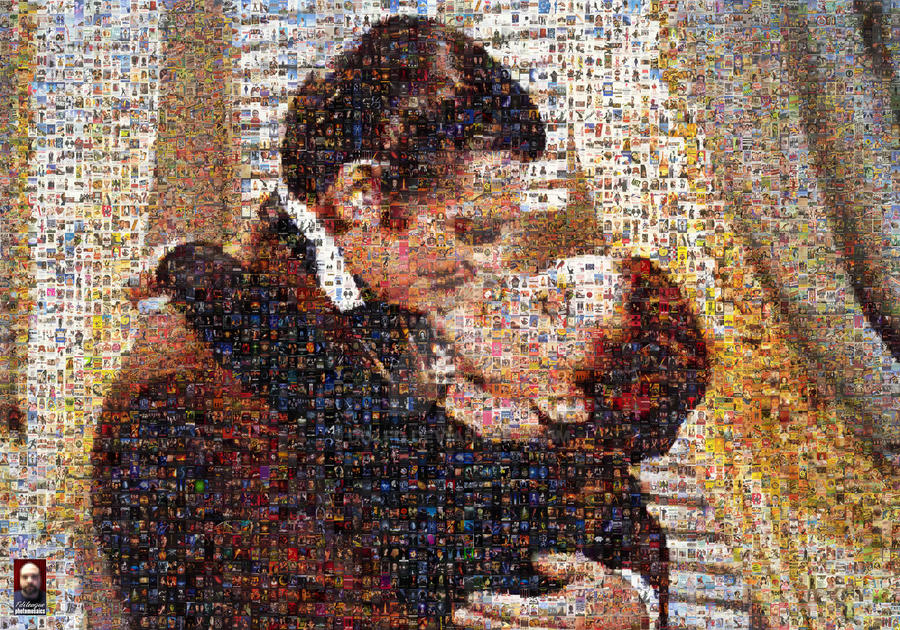
A lot of the art were drawings of scenes from the film, which wasn't too surprising. Some people added different effects to these scenes, like this picture mosaic. 


Others took these scenes a step further by replacing Clark Gable and Vivien Leigh with their own characters.

Friday, April 27, 2012

Is the Author Dead?

Writing About Literature in the Digital Age, an e-Book written by my professor and his students from a previous section of the same class I'm taking right now, has been an interesting read because it's articulated many of the ideas that have been germinating in my brain about blogging. I've tried blogging a few times, actually. Blogging is exciting for me, but at the same time, it often leaves me feeling bewildered and overwhelmed. What if I write something but the readers don't like it? What if it's not interesting? Funny? Clever? Intelligent? Will people quit reading? Will they even start?

Chapters 5 and 6 address the ways in which authors connect with their readers. In Chapter 5, Alyssa Rutter writes about Harper Lee and her unwillingness to connect to her audience. Shortly after To Kill a Mockingbird was published, Lee practically disappeared off the face of the earth after becoming overwhelmed by the popularity of her first novel. I admit I've occasionally daydreamed about being a mysterious author who never talks about her books and leaves the readers to discern the meaning without my influence. But that's hardly been the effect of Harper Lee's silence. Some people actually believe that Lee didn't even write her famous novel. Lee wrote a bestselling novel, but she failed to create an authorial presence. Meanwhile, Toni Morrison is connecting with her audience on all kinds of levels, as Andrea Ostler writes in Chapter 6. Morrison is able to help her readers to understand her book Song of Solomon. Morrison's ability to connect with her audience is producing only positive results, while Lee's readers are left puzzled by her disappearance--if not worse.

Blogging is a great way to take creation of an authorial presence into your own hands. As Rutter points out, if an author doesn't create his or her own online personality, then someone else will. I really enjoy blogging as opposed to other kinds of writing because it's so personal. On blogs, we get to use "I." We get to project our opinions even if they're not perfectly articulated and supported, as Dr. Burton wrote. We get to put our own voice into our writing and sound the way we like to sound. Using Alyssa Rutter's words, we create ourselves online. Blogging is all about creating a relationship between author and reader, a relationship which is becoming not only valuable, but critical in today's literary world. Contrary to Roland Barthes' opinions, the author is not dead, as Andrea Ostler points out. The author is not only alive and well, but being sought after by the readers of literature in the digital age.